Setting Sail into Bellingham Bay

By Nathan Zabel
NSEA Environmental Education Coordinator

The 2020 – 2021 school year was a lesson in being adaptable and flexible in NSEA’s Environmental Education programming, and we were faced with a quick transition to remote learning and the inability to meet students in their classrooms and along waterways throughout Whatcom County. Yet, NSEA’s Education Team continued to embrace the importance of environmental stewardship even in a time of remote learning.

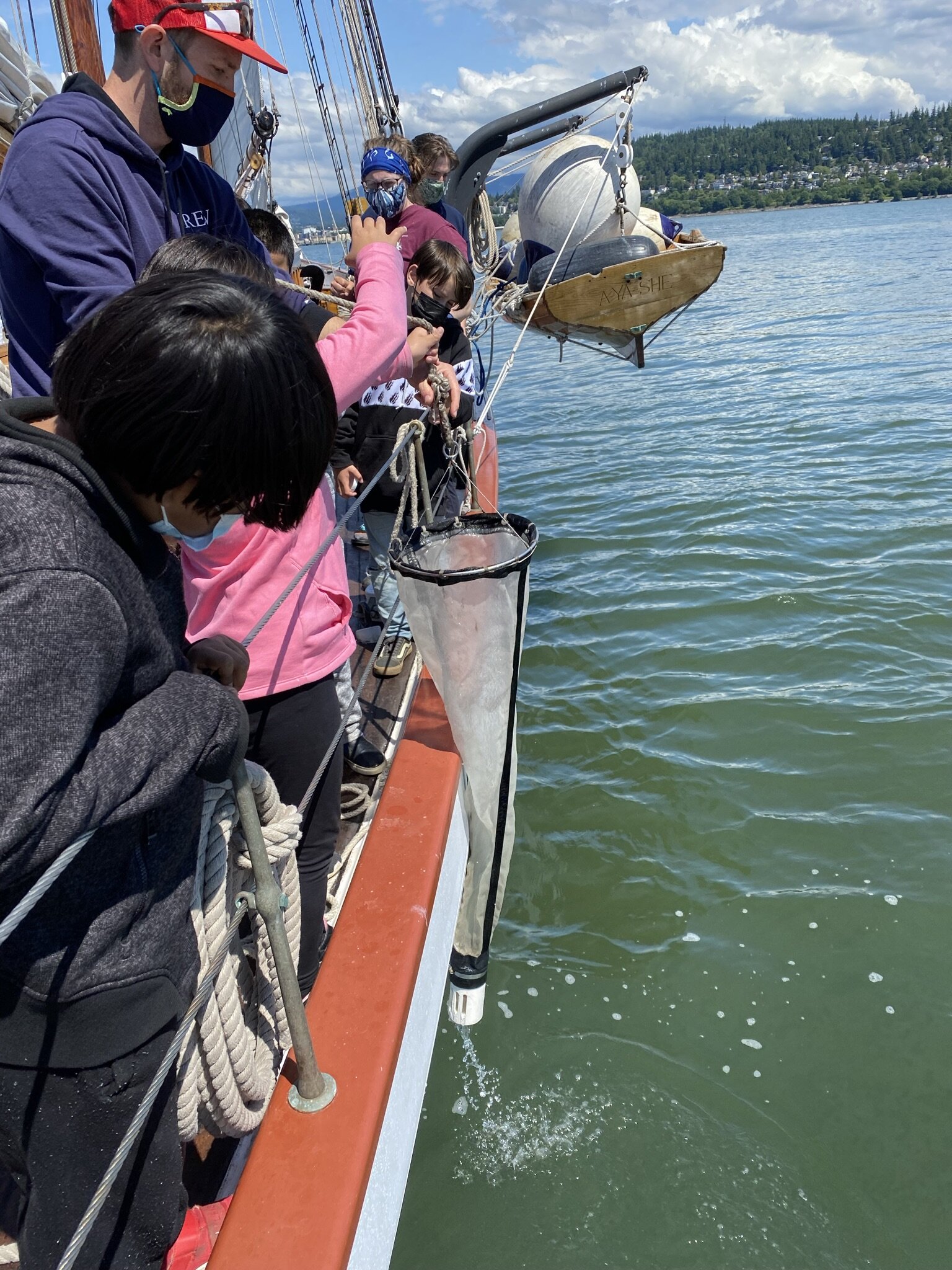
The school year ended with an incredible highlight – sailing excursions aboard Sound Experience’s Schooner Adventuress. This Spring, thanks to funding from EPA, we partnered with Sound Experience and offered a contest to incentivize continued environmental stewardship even in times of remote learning. Teachers submitted their projects, including this video (link) which was submitted by Harmony Elementary. These students created a mural showcasing the Pacific salmon lifecycle, then developed, practiced, and directed a video highlighting the lifecycle along with their “salmon pledges,” or actions they can take in their everyday lives to help salmon. In early June, these Harmony students boarded the 133 foot Adventuress, rigged the sails of the 108 year sailboat, and set sail into Bellingham Bay. While on board, they studied the local marine life, such as Orcas and Harbor Seals, and connected the importance of salmon to these marine mammals. Next, they tossed a plankton tow overboard to collect a sample of plankton. They took the sample to the video microscope, where they got to see tiny organisms like crab larvae and other plankton which salmon rely on as a food source. They looked out to the horizon and identified landmarks such as Mt. Baker and the Nooksack River – all components of their watershed.
This experience connected students to their sense of place from a unique perspective. It also provided a look into the marine environment that is such a crucial component of the salmon lifecycle. NSEA’s Students for Salmon program highlights stewardship that leaves a positive impact along riparian zones through removing invasive vegetation or planting native trees and shrubs. This experience connected those actions students take downstream, to the marine environment, and showcased how students’ choices not only affect the salmon living in their local creeks, but also in Bellingham Bay and the Pacific Ocean.

We are grateful to Sound Experience for their partnership, and honored to be able to continue meet students and their teachers in this unique capacity. For more information about NSEA’s Education programs, please contact Nathan Zabel at nzabel@n-sea.org or call 360-312-3094.

Working with NSEA was the best job in my career

By Wendy Scherrer, aka the Salmon Lady
30 for Thirty #11

In 1985, I was an elementary science teacher and went to Project Wild, Project Learning Tree, Project WET and Adopt-a-Stream teacher training workshops. I initially connected salmon education, learning how to use egg tubes in a stream with my students, and also operating a coldwater egg-to-fry aquarium in my elementary school. WA Dept of Fisheries and WA Dept of Game (now WA Dept, of Fish and Wildlife) and Port of Bellingham, gave our school grants for a salmon tank, boots, supplies for the salmon incubation tubes, and we also did a salmon stream restoration project on Connolly Creek.

The Nooksack-Samish Regional Fisheries Group board was supportive of hatchery fish production and salmon supplementation with eggs and fry in streams. I was a board member from 1986-1989. This group eventually evolved to become the Nooksack Salmon Enhancement Association.

FryRelease2021.Geneve Elem.jpg

As NSEA’s first Executive Director in 1999, I felt that we needed to immediately strengthen the capacity our organization; including getting a stable base of operations, supporting staff with benefits and consistent policies, building a strong volunteer program, getting a strong and diverse board, establishing strong finances by increased funding and fundraising, implementing science-based programs and projects, and increasing collaborations with private citizens, public, nonprofit, business, federal, state and local partners.

NSEA was part of the Nooksack Recovery Team; we worked with tribal, state agencies, farmers, fishers and other partners to work on projects collaboratively, and to implement an annual Salmon Summit conference. I loved the idea of such a diverse group of folks working for common goals—to restore salmon populations. I believe that NSEA’s work in fish barrier removal, restoration of riparian corridors, and education is valued most by the community. I was proud the year we planted 40,000 trees, combining NSEA’s Dislocated Natural Resource Worker crew, WA Conservation Corps/AmeriCorps crews, Whatcom County Sheriff’s office Alternative Correction crews, with added community volunteers! I found that working with the Board and staff was a great adventure, which resulted in lifelong friendships and collaborations. I was happy to be able to leave NSEA with a strong staff, strong financials, and functional base from which to work.

WendyFry Release.HappyValley.3.19.jpg

Working with NSEA was the best job in my career! Having previously worked in the private, nonprofit, and public sectors as an environmental planner and educator, I was happy to work at NSEA with all of the public, private, business, and community partners to get win-win solutions on behalf of the environment.

Today, I continue to volunteer with WDFW and salmon education in the schools, keeping the Salmon in the Classroom egg-to-fry coldwater aquariums going in all of the schools in Bellingham, put some in Ferndale and Everson.

 1986-1989 Board member and volunteer for Nooksack-Samish Regional Fisheries Group.
1999-2007,  NSEA’s first Executive Director
2009-2015 NSEA Education Advisory Committee & volunteer with the NSEA Native Plant Teaching Garden and salmon education in schools.