
A Summer of Salmon!

By Nathan Zabel
NSEA Education Program Coordinator

NSEA_CampKeystone_7.16.21  (5).jpg

This summer, NSEA was excited to pilot a summer camp program – Camp Keystone! Named after the salmon we care so much about, which are a keystone species because of their role as a food source as well as an important nutrient source to fuel ecosystems across the Pacific Northwest.

We transformed our campus into a place where children 4-6 years old got to explore and discover the wonders of the outdoors, rooted in salmon education. 9 weeks of camp featured different ecological themes, such as “Underwater Adventure,” “Furry Friends,” and “Earth Day Everyday.” Each week featured a mix of discovery, science, and silliness!

We started each day with a salmon circle, which included a land acknowledgment, salmon yoga, and salmon songs! Campers learned through movement and music the various stages of the lifecycle and the habitats salmon rely on for survival, while thanking our Indigenous neighbors for caring for the land since time immemorial. After the salmon circle, campers spent the rest of the morning exploring the outdoors through games, arts and crafts, activities, and free play – all facilitated by NSEA’s Camp Educators.

 The week was capped off by a field trip where campers visited a property located in the forest along Tenmile Creek. There, they got to peek into a salmon-bearing creek, play hide and seek among the tall trees, look for bugs under logs, and discover ponds, marshes, and beaver dams! Camp Keystone provided young learners with a space to spark their curiosity, build important social and life skills, and foster an appreciation and connection with the natural world.

 We are thrilled that almost every week of camp was full and we were able to increase accessibility to our Whatcom County community by giving out scholarships for campers to attend. We are humbled by the importance of camp in the lives of these 4-6 year old campers and their families. One parent said “even at the young age of four, he came away with some really great learning experiences, a better understanding of how he is connected to the environment, and was able to have some friends to play with. He is new to the area, and hasn't been able to have friends to socialize with, so this was very important and special for him.” Camp Keystone provided an avenue for youth to play, grow, and explore in the outdoors, while sparking a lifelong learning and compassion for the environment and salmon, a keystone species so important in our region.

For more information about Camp Keystone, please contact Nathan Zabel at nzabel@n-sea.org or call 360-312-3094.

Together, We Can Do It, One Little Piece at a Time

By John Stockman
NSEA Board Member & Bellingham High Science Teacher
30 For Thirty #14

I noticed the blackberry thorns growing in my neighbors’ Clematis back in April. By June, it was reaching over our fence and in July it was tangled in our Scarlet Runner Bean patch. By August it was past time to take action on the invasive species introduced to Seattle by the Eugenicist Luther Burbank, before it takes over the garden. Blackberries can obviously spread easily (just look around western Washington).  They produce giant thickets that shade other native plants and make it difficult to access creek side habitat. Over the 20 years of volunteering at work parties with NSEA, I have seen giant brambles and have the experience now of knowing how to fully remove a blackberry bramble. 

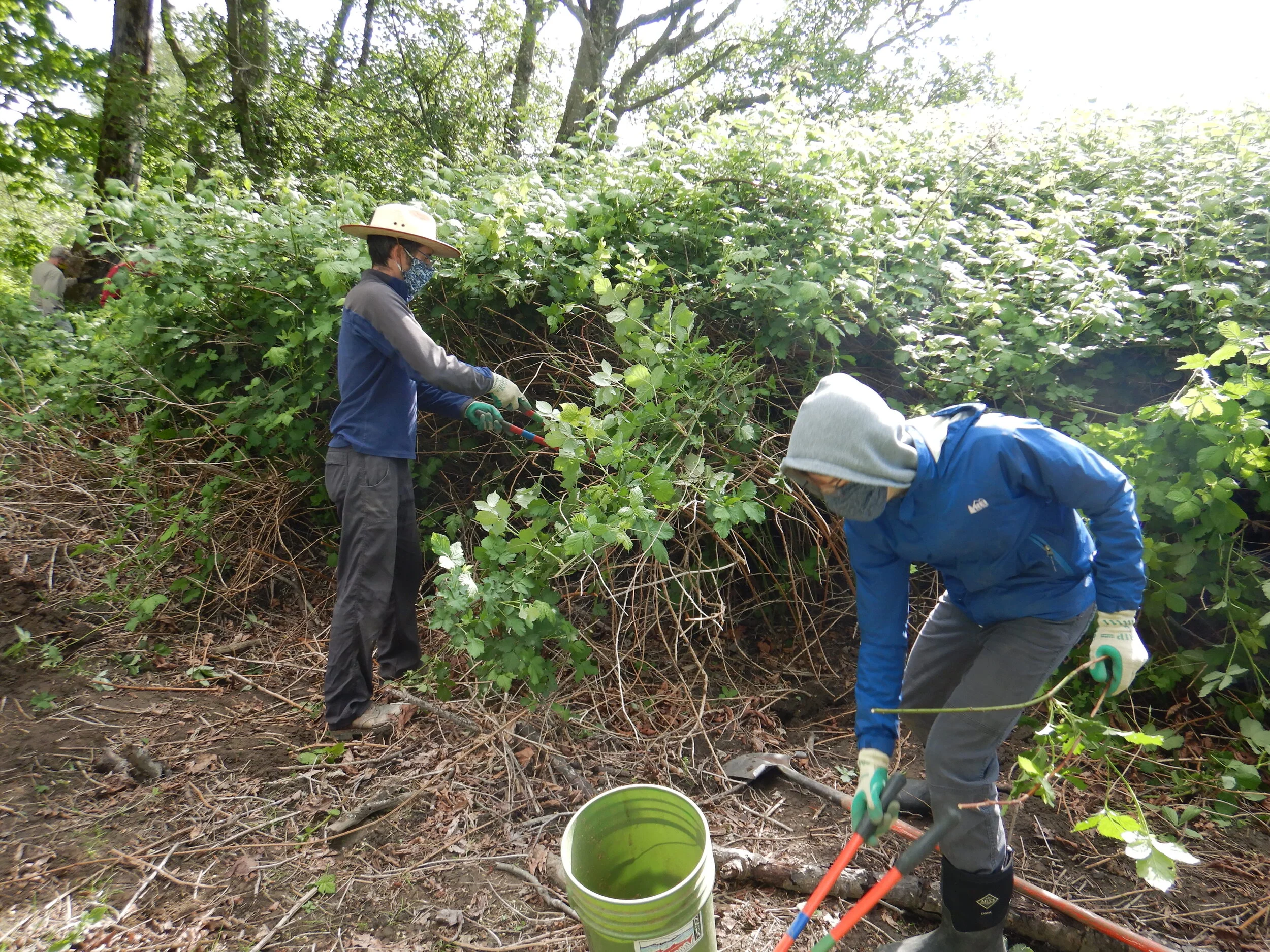
My son and I attended a work party this past spring removing a blackberry bramble the size of a school bus along the Nooksack in Ferndale.  It is not easy work, and a well-established bramble is a stubborn foe.  A problem of this size is extra difficult because of the challenge of not knowing where to start. But it is truly amazing what a dedicated group of volunteers can do together! There was a dozen at this work party of limited size. We worked together for three hours and only put a dent on the prickly monster, but it was a good- sized dent and we knew that reinforcements would return to the site in the future. Like every other work party that I have attended with NSEA, I felt a strong sense of accomplishment and pride working alongside people in my community toward a common goal.  It is this feeling that has kept me returning to work parties year after year.

I got permission from my neighbor to remove our own blackberry bramble. I put on some tough gloves and long pants, pulled out and snipped one long vine, and then stuffed it piece by piece into my compost toter. Over and over again I snipped, and it felt like the bramble was endless.  Vines and thorns twisted and tangled through the garden, slowly and steadily found their way into my bin.  Finally, I got out the shovel, dug down deep, and removed the crown root (aka “the brain”).  My backyard blackberry removal task was complete, but it laid bare the challenges of how to tackle a complex problem.

In the nearly 3 years that I have served on the NSEA board of directors I have learned of some of the heroics performed by dedicated community members over the history of NSEA’s thirty years. I have wondered what it felt like at the beginning of NSEA’s time and I imagine the daunting task of Salmon habitat restoration made it difficult to decide where to start.  But we have done it, one little piece at a time, working together toward this one common mission.  I have toured locations throughout the county to observe new and old projects completed by NSEA staff and volunteers. We have made an impact, we have made a big dent, and yet we still have a lot of work to do.  Together, we can do it, one little piece at a time.  Snip, snip, snip.

Thirty for 30 #14