
NSEA completes first year of Curriculum Teacher Trainings

NSEA’s Students for Salmon (SFS) Program annually serves over 1,600 fourth graders throughout Whatcom County. Students become “stream scientists” and participate in a stewardship project where they leave a positive impact on their local waterway. Supplementing this NSEA-led programming is NSEA’s Students for Salmon Curriculum.  

 This suite of curriculum can be utilized by teachers in their classrooms to extend the learning and bring the program full circle, leaving their students with a deeper knowledge of salmon, the threats they face in our region, and actions they can take to help salmon in their local watersheds. Recently, this curriculum was updated, thanks to a partnership through Western Washington University (WWU) with Dr. Debi Hanuscin and her pre-service teachers. Dr. Hanuscin and her students took NSEA’s existing SFS curriculum and revised it to ensure that it is locally relevant, includes Indigenous Ways of Knowing, builds in climate science, and integrates the power of youth voice.

Over the past year, thanks to funding from NOAA BWET, we have hosted workshops for 40 teachers in all seven Whatcom County public school districts along with tribal schools. These immersive, full-day workshops take place on school grounds within teachers’ districts and allow them to fully engage in the curriculum. NSEA highlights activities teachers participate in through the lens of their students while learning teaching tips to help them feel confident facilitating the curriculum. So far, 100% of teachers have gained confidence in implementing the curriculum and learned more about salmon and watersheds. One teacher said, “This will really help more kids engage in creative learning. To allow kids to become experts and engage them more deeply in hands-on learning is a wonderful addition.”

 NSEA and WWU have also presented at recent Washington Science Teachers Association (WSTA) Conferences and further broadened our impact by showcasing this curriculum to teachers and professionals from around the state. As a result, teachers in schools outside of Whatcom County are utilizing this curriculum to connect their students to watershed and salmon education, along with the impact of their actions on salmon. This connection supports NSEA’s value of the importance of hope in education and how this can empower students to take action in their lives to help salmon, which are so essential to the environment, culture, and economy of our region.

 For more information about NSEA’s Education programs, please contact Nathan Zabel at nzabel@n-sea.org or call 360-715-0283.

The Tale of Two Forks

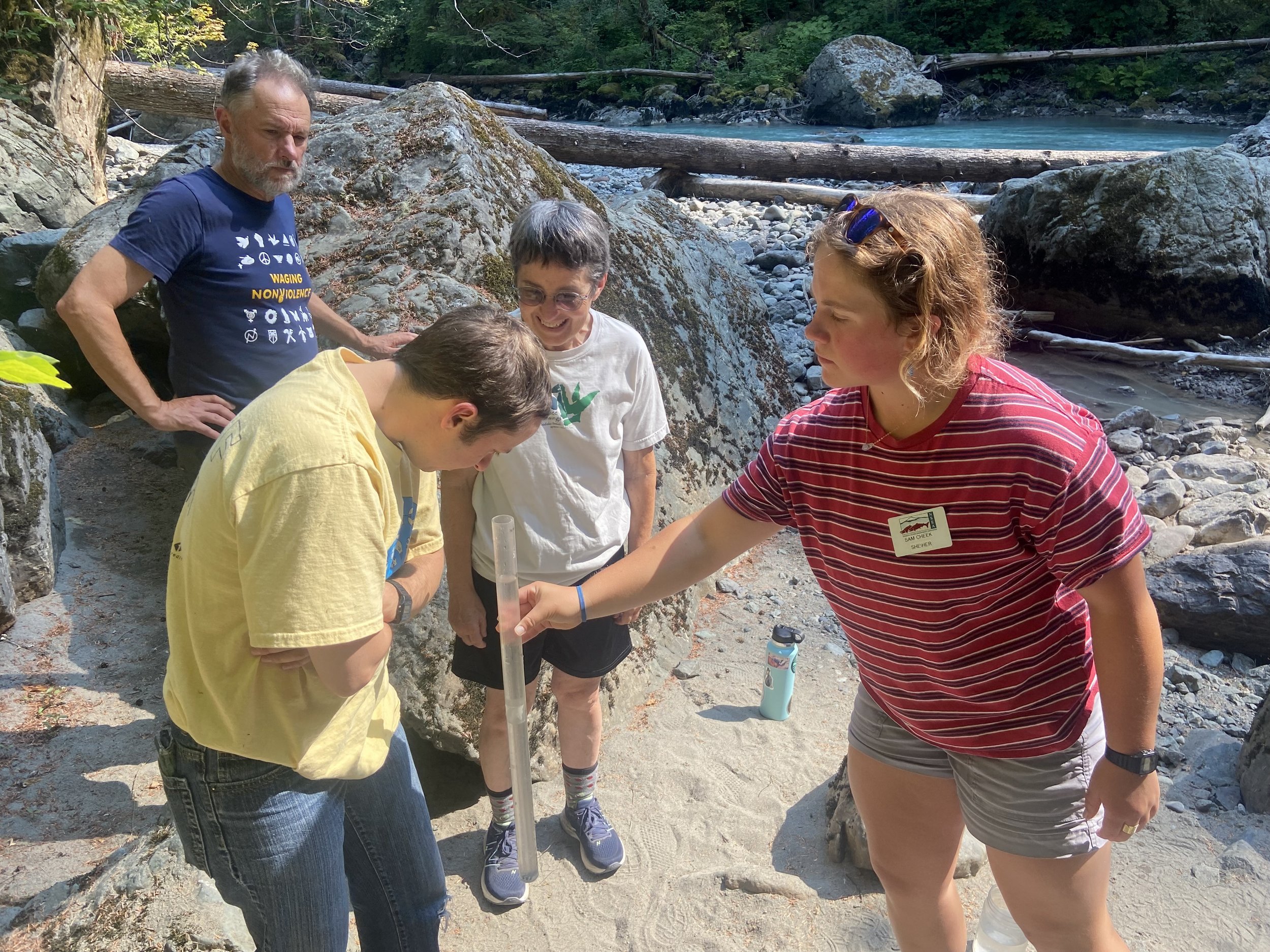
Folks checking the turbidity tube to determine if the water is clear enough for salmon

A LARGE pile of recently removed invasive Himalayan Blackberry and an excited work party volunteer. And that was only one pile that was not the only pile volunteers removed that day!

The Nooksack River Stewards program began as a partnership with the Mount Baker Snoqualmie National Forest to increase capacity for education, outreach, and monitoring in an area along the North Fork Nooksack River. Fast forward nearly 20 years and the program expanded this year to include the South Fork Nooksack River! These two forks of the river couldn’t be more different, surrounding land use, headwater source, flow and temperature all vary, but they are both home to critical Spring Chinook populations that are a priority for recovery in our area. We took different approaches in how programming would look in each fork, but the overall goal was the same: engage the community in ways they can steward salmon habitat while recreating.

Kiddos learning the names of the five Pacific salmon using the fiver finger salmon trick. FYI, Thumb= chum.

Overall, we engaged a total of 2,348 community members and visitors along the Nooksack River! We hosted community work parties in both forks with the Whatcom Land Trust where 57 volunteers removed over 45 cubic yards of invasive vegetation. We had fun making bracelets during salmon storytime at the Whatcom County Library’s North Fork and Deming branches. In Glacier, 61 participants joined us for the Guided River Walks to learn about salmon ecology and conduct water quality experiment along the Horseshoe Bend Trail. And our summer season concluded with hundreds of people witnessing the biennial return of pink salmon at Thompson Creek bridge during our Salmon Sighting events. Down in Acme, we surveyed 130 recreators, collected data on water quality and recreation, and picked up 280 gallons of trash!

The booth along the South Fork.

Thank you to Nooksack River Stewards partners and funders: Whatcom Land Trust, Mt Baker Snoqualmie National Forest, Whatcom County Library System, Nooksack Indian Tribe, WRIA 1 Salmon Recovery Lead Entity, Whatcom County Public Works, Tomberg Family Foundation, and Drinking Water Providers Partnership.

P.S. Our South Fork programming included much more than could fit here. Visit www.nooksacksalmon.wordpress.com for more details on that initiative including our community survey and data collection results.

By Sarah Brown, NSEA Stewardship Programs Manager